
Funding the Future: Business Innovation for Public Service Media
Funding the Future: Business Innovation for Public Service Media
Overview
You see your budget shrinking year after year, and it feels like there’s no end in sight. What if you could develop your own sources of funding, without compromising your public service mission? This course will help you explore innovative business models tailored to the unique challenges of public service media. Through real-world tools and frameworks, you’ll work on your own project—from idea to implementation—designed to strengthen revenue generation, sustainability and impact. Whether you're adapting an existing model or launching something new, this course equips you to lead with creativity and purpose.
"Business models are increasingly the key determinant of successful innovation projects, and innovation in business modeling is increasingly the differentiating (or disrupting) dimension of any successful new project or business. This is a complex, adaptive challenge. Technology won't fix it!" - Prof. Alon Rozen, Dean École des Ponts Business School
Who is it for
Senior Executives and Directors
- CEOs, COOs, CFOs of public broadcasters
- Directors of strategy, innovation, or transformation
- Heads of content, distribution, or digital media
Strategy and Innovation Leaders
- Heads of innovation labs or future media departments
- Managers leading new product development or digital initiatives
- Staff involved in audience development or data strategy
Business Development and Finance Professionals
- Professionals responsible for revenue diversification
- Those exploring new partnerships, funding models, or commercial arms of PSM
Schedule
- First online session: January 13, 2026
- Face-to-face session in Paris: February 3-5, 2026
- Second online session: March 17, 2026
At the end of the programme, each participant will get a certificate co-signed by École des Ponts Business School and EBU Academy.
Learning Objectives
By the end of this course, you will be able to:
Assess the challenges and opportunities facing public service media in a rapidly evolving media, technology and funding landscape.
Apply business model frameworks (e.g., Business Model Canvas) to design sustainable models aligned with public service values.
Identify diverse revenue opportunities and funding strategies that support editorial independence and mission-driven impact.
Develop and iterate your own business model project, from initial concept to implementation planning.
Communicate your business model clearly to internal and external stakeholders, building support for innovation and change.
Course Programme
This new programme will be delivered in a hybrid format: Phase 1 and 3 will be delivered online, and Phase 2 will be face-to-face in Paris.
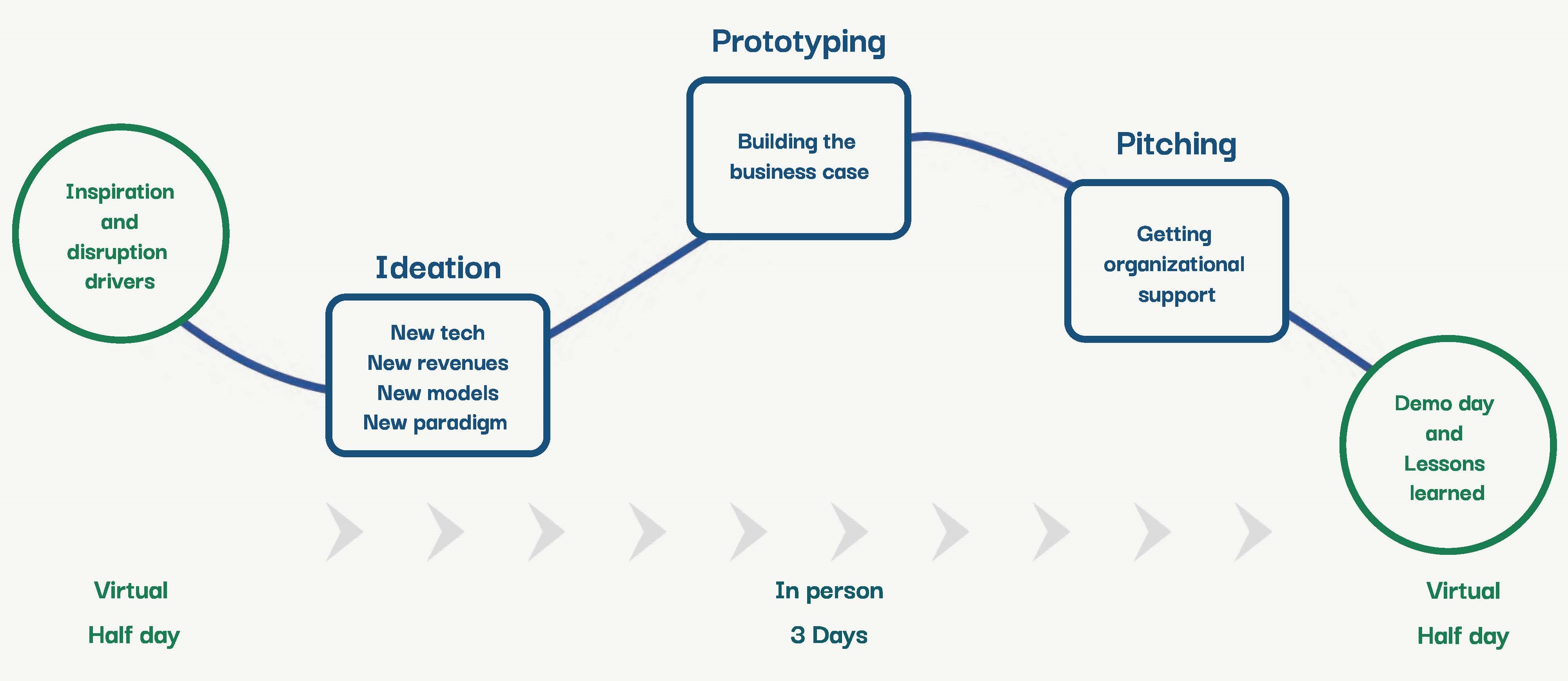
Course outline:
Phase 1: Opening online session: Inspiration and Disruption Drivers
This interactive session begins with an inspirational segment, featuring fresh perspectives from industry experts and thought leaders. It focuses on key disruption drivers — from technological innovation to shifts in business models. At the end of this session, each participant will be asked to start thinking about ideas for new business innovations.
Phase 2: 3-day Face-to-face session: Ideation – Prototyping – Pitching
Following the inspirational opening session, Day 1 is designed to spark participants’ creativity while introducing the lean innovation methodology. This framework will help them shape their ideas and apply them effectively within the dynamic business model canvas used to develop their business case.
Day 2 focuses on developing the business case. Using the dynamic business modeling framework, participants will continue to challenge, refine, and strengthen their innovation projects, with the goal of producing a compelling business case to present to their organization.
Day 3 is dedicated to transforming each innovation idea into a clear and compelling project proposal, designed to secure organizational buy-in and support for implementation. The day concludes with formal presentations of the proposals to a jury.
Following this session, each participant will be expected to present his/her project in his/her own organization before the follow-up session.
Phase 3: Follow-up online session: Lessons learned
This final follow-up session, held 6 weeks after the in-person workshop, offers participants an opportunity to reflect collectively on their experiences and share the challenges encountered during the presentation and the implementation of their projects within their own organization.
Our Academic Partner
Ecole des Ponts Business School
Since 1987, the École des Ponts Business School has been helping companies and executives grow and transform themselves. The professors, invited from the best universities from around the world, bring a unique perspective on their respected fields. Cross-cultural diversity and a pioneering spirit have forged the reputation of its MBA and DBA programs, offered in Paris, Casablanca, Shanghai and Beijing. Internationally-accredited by AMBA, the school shares the same standards of excellence as its Alma Mater, École des Ponts ParisTech.